


Over the past few days, several customers have asked us the same question: What does the new EU rule against greenwashing mean for us and our advertising? For the tree counter on the website, for the widgets, for the stands on the tables?
The short version first: if you work with ReviewForest, you have already done the hardest part. Every review is counted, and every tree is listed publicly in your review forest with its planting partner and region. That’s exactly the kind of concrete statement the law allows. Still, it’s worth taking a look at the sentences around it, on your website, in your social media posts and on whatever is hanging on your wall. Usually it comes down to a handful of words.
The short answer
Since 27 September 2026, new rules for advertising with environmental claims apply across the whole EU. Concrete claims you can back up remain allowed. “We plant a tree for every review” is one of those. What is banned: generic environmental words without an explanation, “climate neutral” based on offsetting projects, homemade seals, and claims that stretch one small green part to cover the whole business. In Germany there’s no transition period. So far, enforcement has mostly targeted large corporations, airlines and retail chains. For a small business the risk is low, but the rules apply to everyone, and adjusting usually costs only a few words.
What changed on 27 September
In 2024 the EU adopted Directive (EU) 2024/825, known in legal circles as “EmpCo” (short for Empowering Consumers for the Green Transition). It has applied across the EU since 27 September 2026, and each member state implements it in a law of its own. Germany did so with the Third Act Amending the UWG of 12 February 2026, the UWG being the German Unfair Competition Act.
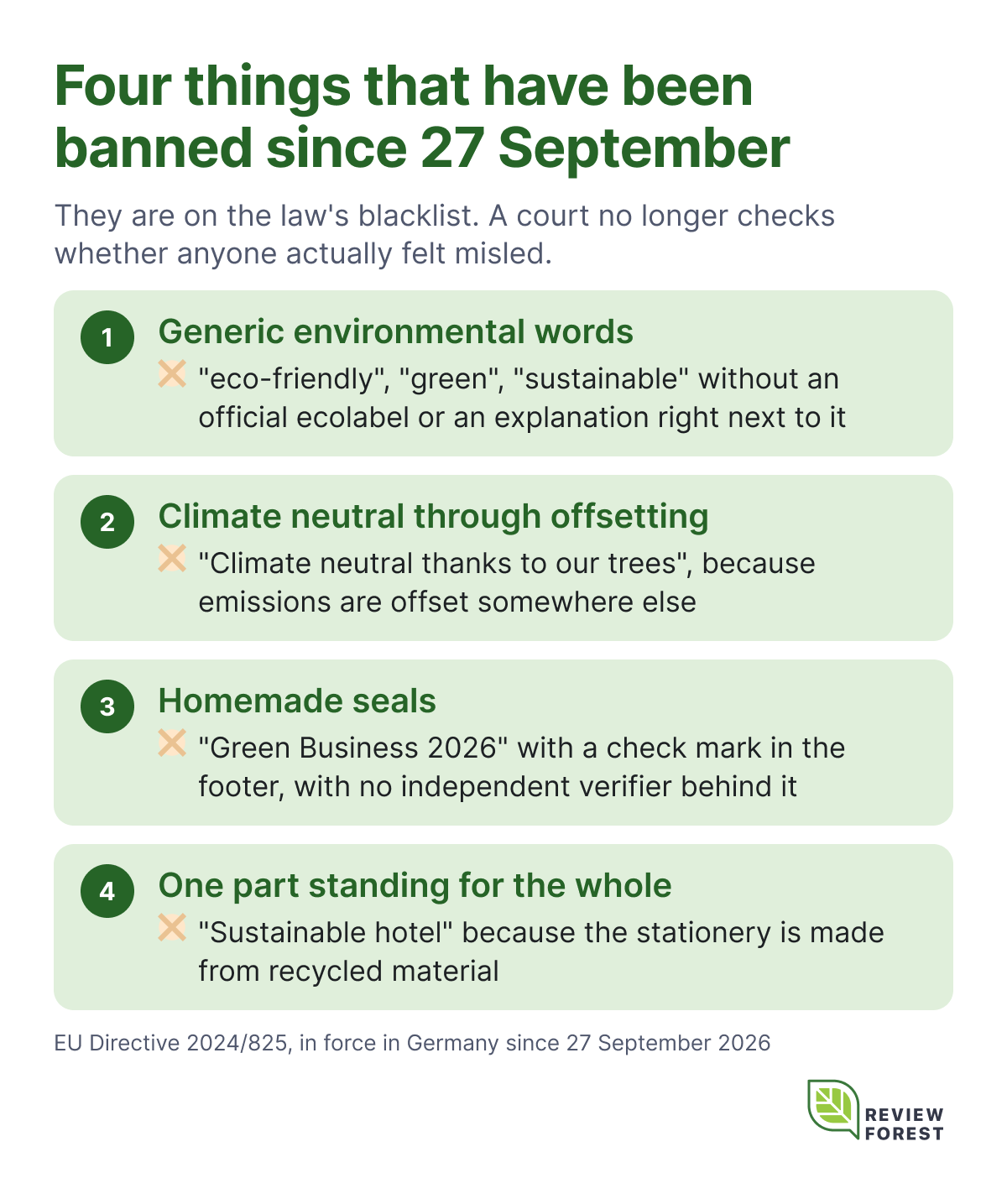
The core is a set of new entries on the so-called blacklist in the annex to the UWG, which mirrors Annex I of the EU Unfair Commercial Practices Directive (UCPD). Whatever is on that list is “always prohibited” toward consumers. A court no longer checks whether anyone actually felt misled in the individual case. Four points affect almost everyone who advertises with the environment:
- Generic environmental words (Annex No. 4a UWG, Annex I No. 4a UCPD). “Environmentally friendly”, “green”, “ecological”, “climate friendly” and similar buzzwords are only allowed if you can demonstrate “recognized excellent environmental performance”. In practice that means an official ecolabel such as the EU Ecolabel or Germany’s Blue Angel, and even then only for the properties the label covers. The alternative is to explain the claim “clearly and prominently on the same medium”, in other words right next to it. The directive gives its own example: “climate-friendly packaging” is generic, “100 % of the energy used to produce this packaging comes from renewable sources” is specific (recital 9). The directive also names “sustainable” and “responsible” explicitly (recital 10).
- Climate neutral through offsetting (Annex No. 4c UWG, Annex I No. 4c UCPD). You can’t claim that a product is climate neutral, has reduced CO2 or is climate positive if that claim rests on emissions being offset somewhere else. In its questions and answers on the directive, the European Commission gives the typical example of a flight that is supposed to be climate neutral because the airline invests in a rainforest reforestation project. That is pretty much exactly our topic.
- Homemade seals (Annex No. 2a UWG, Annex I No. 2a UCPD). You may only display a seal about environmental or social characteristics if there is a certification scheme with an independent verifier behind it, or if a public authority awards it. A badge you design yourself, say “Green Business 2026” with a check mark in the footer of your website, is such a seal: it looks like an award, but nobody independent has checked anything.
- One part standing for the whole (Annex No. 4b UWG, Annex I No. 4b UCPD). If only the packaging is made from recycled material, “the product” is not “sustainable”. And if you have trees planted, “your business” is not automatically “sustainable”.
On top of that there’s a rule for promises about the future: “We will be climate neutral by 2030” only works with a detailed, publicly available implementation plan that an independent expert checks regularly (Section 5(3) No. 4 UWG).
The blacklist applies to advertising aimed at consumers. It doesn’t apply to advertising aimed at other businesses, but the general ban on misleading advertising still does, and on environmental topics it’s strict. In 2024, Germany’s Federal Court of Justice ruled on an ad in a trade magazine that a term like “climate neutral” has to be explained “in the advertisement itself” (BGH, judgment of 27 June 2024, I ZR 98/23).
You can keep advertising tree planting, but not “offsetting”
This is the part we were most interested in, and the answer is refreshingly clear. Both the directive and the explanatory memorandum to the German act say explicitly that businesses may continue to advertise their commitment. The memorandum says businesses are “not prevented […] from advertising their investments in environmental initiatives (including the purchase of carbon credits)” (Bundestag printed paper 21/1855, explanatory note on No. 4c). The condition: the information must not be misleading.
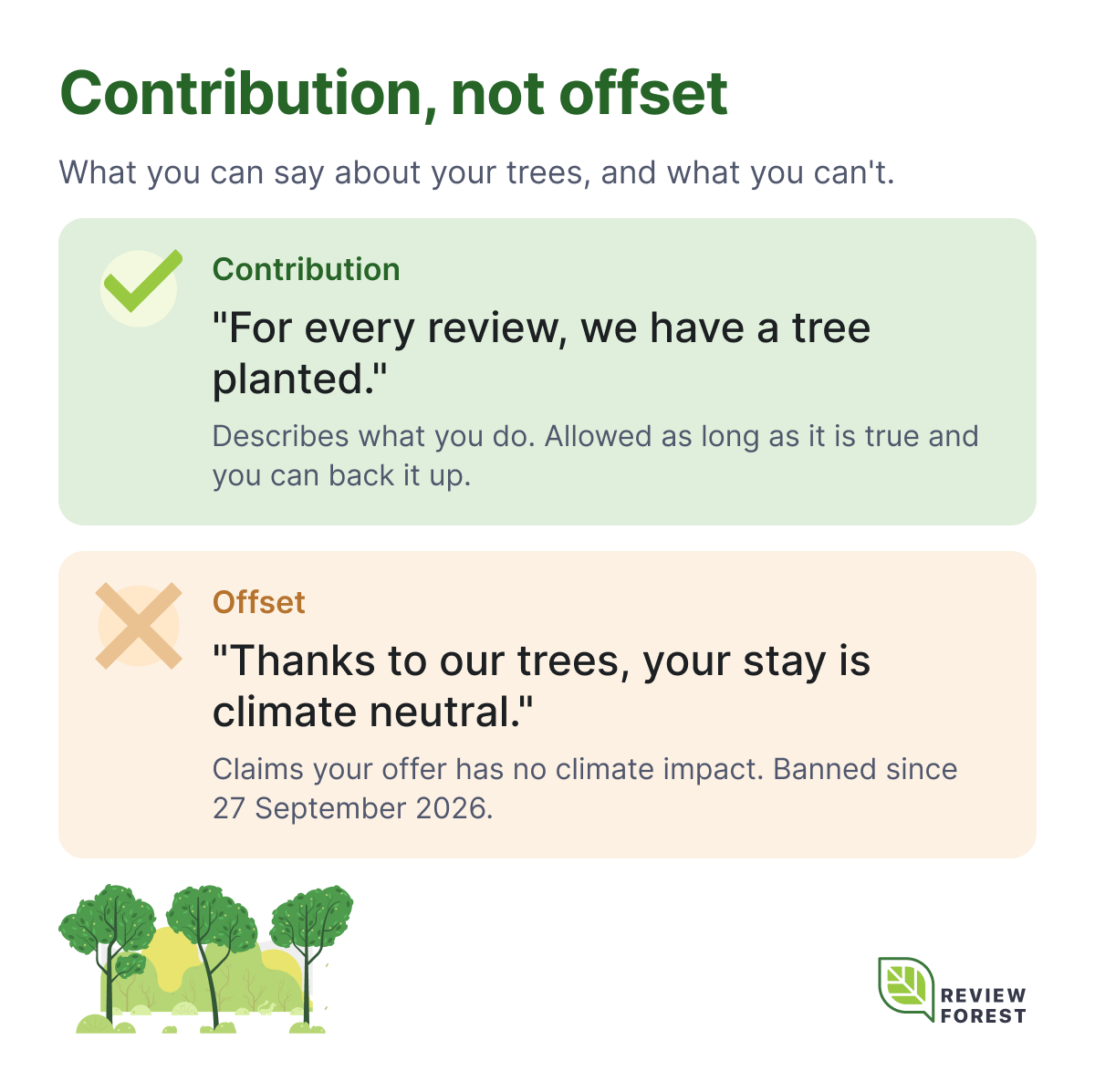
So it comes down to the sentence around the tree:
- Contribution: “For every review, we have a tree planted.” That describes what you do. Allowed, as long as it’s true and you can back it up.
- Offset: “Thanks to our trees, your stay is climate neutral.” That claims your offer has no climate impact because a tree is growing somewhere else. Banned.
Switzerland, by the way, has drawn this distinction for a while, and very clearly. In its implementation guide on climate-related claims, the Federal Office for the Environment describes a “climate protection contribution” that a business finances without netting it against its own emissions, and states: “Such contributions do not count as offsetting.” That is the best short formula we know: contribution, not offset.
For us this isn’t a change of course, it’s the line we’ve followed from the start. Having trees planted doesn’t give you a free pass on everything else you do to the climate, and a tree doesn’t offset anything. That’s why “climate neutral” has never appeared in our texts, and why we’ve advised customers against writing it themselves. A seedling that goes into the ground today will bind CO2 over many years. How much depends on the species, the location and whether it survives. It’s a contribution to reforestation, and we claim nothing more. We think it’s right that the law now draws the line at exactly this point.
Before and after: examples from everyday life
The examples are deliberately ordinary. Replace the placeholders in square brackets with your real numbers, and the “after” sentences only work if they are true for you.
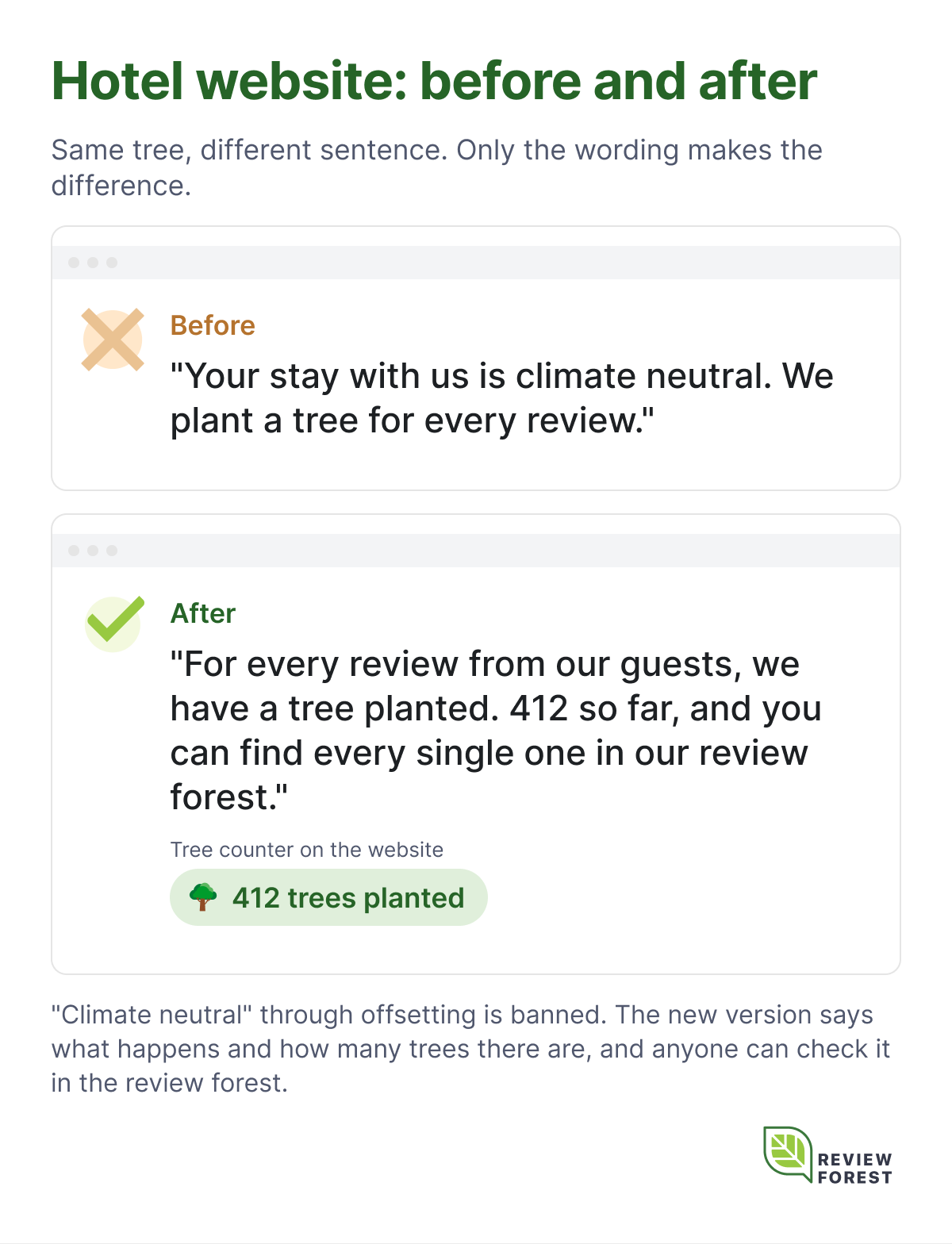
Hotel, website
- Before: “Your stay with us is climate neutral. We plant a tree for every review.”
- After: “For every review from our guests, we have a tree planted. [412] so far, the tree counter at the bottom of the page shows the current number, and you can find every single tree in our review forest.”
- Why: “climate neutral” through offsetting is banned under No. 4c. The new version says what happens and how many trees there are, and anyone can check it. Who plants and where is on your review forest page, which the counter links to.
Restaurant, menu
- Before: “Enjoy sustainably in our green restaurant.”
- After: “Our vegetables come from [three] farms in the region: [Farm A], [Farm B], [Farm C].”
- Why: “sustainable” and “green” are generic (No. 4a). The specific statement is fine if it’s true.
Clinic, about page
- Before: “We are an environmentally friendly clinic.”
- After: “Since [2025] we have heated our treatment rooms with a heat pump.”
- Why: No. 4a. Say what you actually do instead of rating it.
Table stand
- Before: “Your review saves the climate!”
- After: “Your review plants a tree. See all the trees here: [QR code to the review forest]”
- Why: “saves the climate” is generic and exaggerated. A tree doesn’t save the climate, it’s a contribution.
Instagram post
- Before: “We are a sustainable business because we plant trees 🌳”
- After: “Thank you for [50] reviews in September! We are having [50] trees planted for them. You can see every single one in our review forest, link in bio 🌳”
- Why: The trees are one part of what you do, not your whole business (No. 4b), and “sustainable” is generic (No. 4a).
Badge in the website footer
- Before: A seal you designed yourself, reading “Green Business 2026, verified”.
- After: A counter with the real number and a link to the list of all trees, without the look of a seal, without a year and without “verified” or “certified”. Or a real ecolabel: for accommodation businesses there is, for example, the EU Ecolabel for tourist accommodation.
- Why: No. 2a bans sustainability seals without an independent certification scheme.
Promises about the future
- Before: “We will be climate neutral by 2030.”
- After: Either with a public plan that names measurable targets, deadlines and a budget and that an independent verifier checks regularly. Or you talk about what has already happened: “In 2025 we used [18 %] less electricity than in 2024.”
- Why: Section 5(3) No. 4 UWG.
How to communicate tree planting the right way
These nine points fit on a note next to the register.
- Say exactly what happens. One tree per review, per booking, per month. No paraphrasing.
- Name the partner and the region, or link to them. With ReviewForest both are on your review forest page, and the tree counter links to it.
- Show the proof. A link to a page where every tree is listed individually is the best proof you can have. With ReviewForest that is your public review forest.
- Contribution, not offset. Cut “climate neutral”, “carbon neutral”, “climate positive”, “offset” and “compensated” as soon as they rest on your trees.
- No generic words without an explanation right next to them. “Sustainable”, “green”, “environmentally friendly”, “help the planet”: either what exactly is meant stands right beside it, or the sentence goes. For words like “climate neutral”, a link to an explanation is usually not enough after the Federal Court of Justice ruling. The explanation has to sit right with the claim.
- Do not stretch it to cover your whole business. The trees are one part of what you do.
- Be honest about timing. Planting happens in the project’s planting season, not on the day of the review. “For every review, we have a tree planted” is true as long as you do that. “We planted 50 trees today” only if that is really what happened.
- Numbers and impacts only with a source. The number of your trees is proven, because every single one is in your review forest. Only quote an amount of CO2 per tree if you have a reliable source for it, because it depends heavily on species, location and age. The same goes for animals: nobody can promise that a particular seedling will give a bat colony a home. Saying that the project restores habitat for native species is on safer ground.
- No seal look. No stamp with a year, no “certified” or “verified” unless an independent certification scheme is behind it. A number with a source is not a seal. A round button reading “Green Business 2026” is.
What if the text came from your service provider?
This question came from an agency that installs widgets for its clients. The short answer: the text on your website or on your table is your advertising, even if someone else wrote it. The UWG applies to anyone who carries out an unlawful “commercial practice”, and that covers any conduct for the benefit of your own or someone else’s business (Section 2(1) No. 2 and Section 8 UWG). The provider may be liable on top, but “that’s just the widget” doesn’t protect you.
For web designers and agencies that means: if you install widgets for clients or take over their texts, a quick look at environmental claims is a pretty good service right now.
For our own widgets: the texts come live from us. When we change a sentence, it changes on all websites at the same time. Printed stands and posters don’t, of course.
What happens if you get it wrong anyway?
Honest answer: usually nothing, at first. You shouldn’t count on that, though. In Germany no authority systematically monitors websites. Competition law is enforced by competitors, the Wettbewerbszentrale (the German center for protection against unfair competition), the consumer advice centers and Deutsche Umwelthilfe, an environmental organization (Section 8(3) UWG). The tool is the cease-and-desist letter, known in Germany as an Abmahnung: you are asked to sign a declaration that you will stop, and to cover the costs. From an association that’s a flat fee of a few hundred euros. From a lawyer it depends on the value in dispute, around 900 to 1,800 euros net, plus your own legal fees. If you refuse to sign, you risk a preliminary injunction: a court can then ban the advertising within a few days, and the costs multiply. If you sign and then use the sentence again, you pay a contractual penalty. Fines are only provided for widespread infringements across several EU countries, which in practice means large companies.
Deutsche Umwelthilfe has announced that it will “take legal action against significant breaches of consumer protection” (press release of 21 September 2026). Its cases so far have targeted Apple, airlines and large online retailers, not the guesthouse on the edge of the village. So for a small business the risk is low, but not zero. What remains is the competitor who gets annoyed and the guest who asks questions. Against both, a concrete sentence helps more than a big word. And the concrete sentence is usually the better one anyway.
What about posters that are already up?
There’s no general transition period in Germany. The explanatory memorandum notes that courts can grant “reasonable periods for using up stock, removal and changeover” in individual cases (Bundestag printed paper 21/1855, explanatory note on Article 2). We wouldn’t rely on that. For packaging that has already been printed, the European Commission’s questions and answers pragmatically suggest covering problematic claims with stickers.
In practice: change online texts right away, that’s quick. That also goes for old social media posts that are still public: if you wrote “climate neutral” there, edit the post or delete it. Replace printed material with problematic sentences, or put a sticker over the sentence. And a stand that only says “Your review plants a tree” can simply stay where it is.
One small point that is easily overlooked: if a template says “100 % recycled paper” and you print it yourself on ordinary paper, the sentence is no longer true. Then it has to go.
Austria also implemented the directive as of 27 September (Federal Law Gazette I No. 58/2026). There is a three-year grace period there, but only for goods placed on the market before the cutoff date, not for advertising on websites. In Switzerland EU law doesn’t apply, but since 1 January 2025 claims about climate impact must be “capable of being substantiated by objective and verifiable grounds” (Art. 3(1)(x) of the Swiss Unfair Competition Act), and the distinction between contribution and offset is, as described above, already established practice there.
What ReviewForest takes off your plate
The idea behind ReviewForest was, from the start, that you can advertise with trees without having to fend off greenwashing accusations. The new law doesn’t change that, it confirms the approach. Specifically:
- The core claim is the permitted one. “One tree per review” is a verifiable contribution, exactly what the directive and the explanatory memorandum explicitly allow (see above). No offset, no generic word, no seal.
- The proof is already there. Every tree is listed publicly in your review forest, with planting partner and region. You don’t have to collect or prove anything, the link is enough.
- We maintain the texts. Widgets and review forest pages pull their texts live from us. We have gone through them with the same list you see above and made them more precise in a few places. If the law changes again, we change the texts, and on your site that happens by itself.
- The templates in the dashboard have been checked against these rules. Whatever you downloaded, printed or posted before that, give it one look yourself.
Avoiding greenwashing was a principle for us long before it was in the law. We say specifically what happens and show every tree. We don’t promise offsetting. That’s why our review was short, and why “Your review plants a tree” stays exactly as it is. The sentences around it are the part you control. That’s what this post is for.
Do this today
If you only do three things, make it these:
- Search your website, menu and social media profiles for “climate neutral”, “sustainable”, “green” and “environmentally friendly”. Cut “climate neutral” wherever it rests on your trees. Explain the other words concretely right next to them, or cut them.
- Next to your tree counter, leave only the number and a link to all the trees. No homemade seal, no “verified”.
- Replace printed stands and posters that use one of the words from point 1, or put a sticker over the sentence.
The new law doesn’t take environmental advertising away from anyone, only the shortcut through big words. If you say specifically what you do and can show it, there isn’t much left to do.
Not legal advice. We are not a law firm. This post summarizes what is in the law, the explanatory memorandum and the European Commission’s guidance, and links every source. For your specific case, please ask a lawyer specializing in competition law, your chamber of commerce (IHK) or your trade association.
