


We have great news: From now on, we’re planting with a new partner: Trees for the Future in Uganda!
Our previous partner Eden Reforestation Projects unfortunately discontinued their Kenya project and significantly raised prices. With Trees for the Future, we’ve found a wonderful new partner that supports families in Uganda in building a sustainable future through trees.
About Trees for the Future
Trees for the Future (TREES) is a nonprofit organisation registered as a 501(c)(3) with the US tax authority. Since 1989, TREES has been working with smallholder farmers in sub-Saharan Africa, planting more than 400 million trees and changing the lives of over 350,000 people.
The organization was recognized by the United Nations as a “World Restoration Flagship”, - an acknowledgement of one of the best large-scale ecosystem restoration projects worldwide.
The Forest Garden Approach
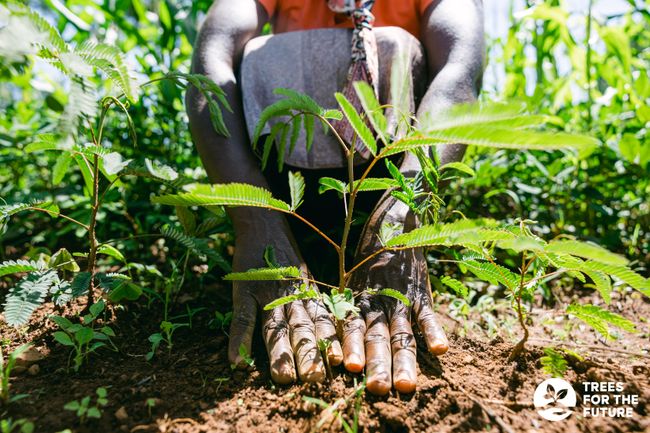
What makes Trees for the Future special is their method: the Forest Garden Approach. This is a four-year training program in which local TREES staff train smallholder farmers directly on site.
Farmers learn through 16 training modules how to establish their own tree nurseries, harvest and store seeds, apply agroforestry techniques, manage pests without harmful chemicals, improve their soil with compost, and implement climate-smart solutions.
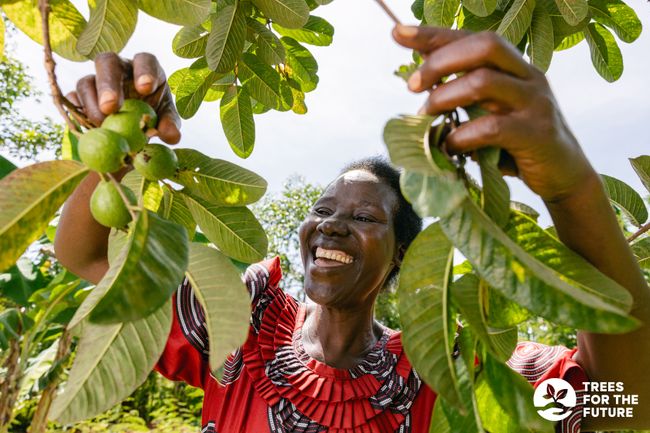
Over the course of the program, farmers plant thousands of trees and dozens of fruit and vegetable species on their own land. This creates so-called “Forest Gardens” – small but powerful systems of trees, vegetables, and crops that restore the soil, provide food, and generate income.
The Ecological Significance of the Project
Forest Gardens combat climate change on multiple levels: The planted trees capture CO₂, restore groundwater tables, and protect farmers’ land from the more intense and unpredictable weather events caused by climate change.
The trees are planted to grow permanently and play a sustainable role in the ecosystem. They provide shade, protect crops, and prevent soil erosion. Through regular pruning of fast-growing hedges and shrubs, farmers obtain mulch material and animal fodder. This also improves biodiversity: insect and plant diversity as well as soil quality increase significantly.
The Social Significance of the Project
The Forest Garden Approach transforms not only the environment but also the lives of entire families. Before the program, many farmers grow only one or two crops, - often not enough to feed the family throughout the year.
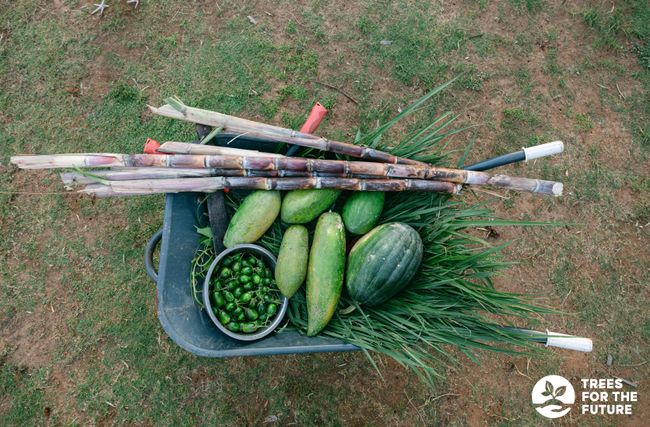
With a Forest Garden, families have a diverse selection of food available year-round. By selling vegetables, fruit, and other produce, they generate additional income that allows them to pay school fees, invest in livestock, and run their household with dignity and independence.
In this way, Forest Gardens break the cycle of poverty and create sustainable opportunities for future generations.
If you have any questions, please get in touch, - we’d love to hear from you!
