


We needed a roofer for two old apartment buildings in Berlin: clean the gutters and fix a few small things on the gutters and downpipes while they’re up there. Instead of flipping through a directory, we did what more and more people do. We asked AI.
Four of them, in fact. ChatGPT, Claude, Gemini and Google’s AI Mode all got the same question, asked in German: “I live in Berlin-Steglitz and I’m looking for a good roofer who cleans gutters and fixes small damage to the gutter and downpipe while they’re at it. Which three businesses do you recommend, and why?”
Four apps, nine different businesses. Every AI had its own list. To keep things easy to follow, we’ve given the businesses tree names instead of their real ones, like roofer Linden or gutter cleaner Alder. This isn’t about who the best roofer in Berlin is. It’s about why AI recommends whom.
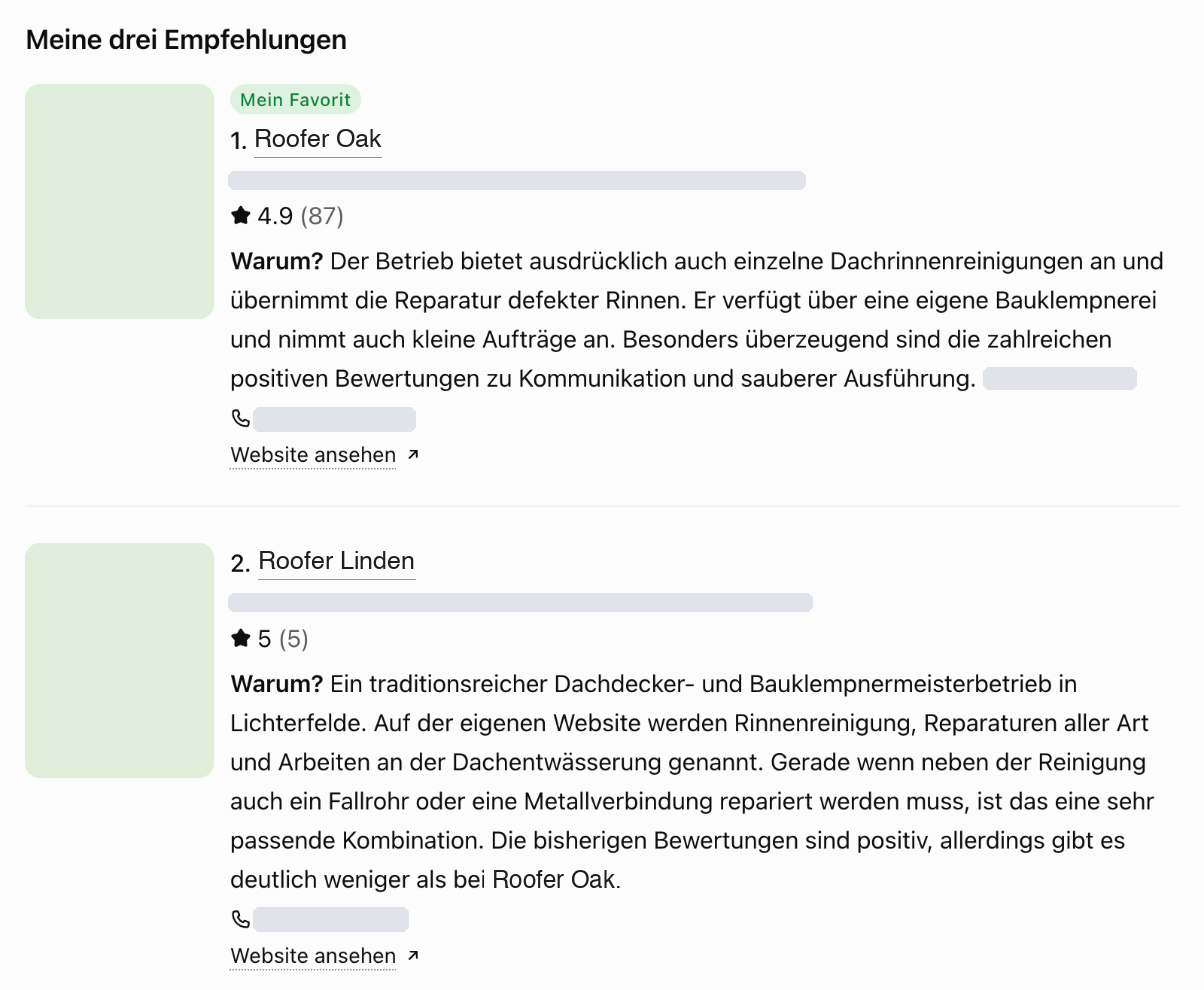
One business still showed up in three of the four answers, twice in first place. We call it roofer Oak. With 4.9 stars from 90 Google reviews, it has more reviews than any other roofer in our search results.
One question, four answers
Nine different businesses. Only one shows up in three of the four apps: roofer Oak, the business with the most Google reviews in our search.
 ChatGPT
- 1 Roofer Oak
- 2 Roofer Linden
- 3 Roofer Birch
Stars in the answer
 Claude
- 1 Roofer Maple
- 2 Roofer Beech
- 3 Roofer Oak
Stars in the answer
 Google AI Mode
- 1 Roofer Oak
- 2 Roofer Pine
- 3 Gutter cleaner Alder
Stars only indirectly
 Gemini
- 1 Gutter cleaner Willow
- 2 Gutter cleaner Poplar
- 3 Roofer Beech
No stars
We then took a closer look at where the AIs get their information and why they recommend whom. That’s where the seven tips below come from. We tested this with roofers, but the tips carry over to most local businesses, from electricians to auto repair shops.
First: where AI recommendations come from
The AIs look in two places, sometimes more in one, sometimes more in the other, depending on the app and the question.
Map data with reviews. In our test, ChatGPT and Claude showed map listings with star ratings and review counts, and used them as arguments. ChatGPT wrote about roofer Oak that the many positive reviews strengthened its confidence. Claude even read the text of the reviews and concluded that the business mostly takes on large projects.
The open web. For our question, the Gemini app searched the web. In that case, what counts is what’s on your website and what business directories say about you. Stars didn’t come up in Gemini’s answer at all.
Two routes to a recommendation
What counts depends on where the AI looks.
Route 1
Map data
- Star rating and number of reviews
- What the reviews say
- Categories and opening hours
In our test:
ChatGPT Claude Has the edge: whoever has lots of good reviews
Route 2
Web search
- Your website, page by page
- Business directories
- Trade association lists
In our test:
Gemini app AI research agents and APIs Has the edge: whoever answers the question word for word on their website
Why professional AI tools answer differently from the apps
Before we tried the apps, we had already run the search with AI tools that companies and developers use: a research agent (OpenAI’s Codex) and Gemini through its API, with no app around it. That time we used a detailed research brief that explicitly asked for master craftsman status and guild membership and wanted reviews only “if available.” The results looked completely different.
These tools only searched the web and didn’t open Google Maps once. They only knew about reviews secondhand, from directories that copy Google reviews, and some of those numbers were outdated or wrong. The research agent put roofer Larch (3 Google reviews) in first place, even though it hadn’t found a single review for it, and put roofer Fir (41), the business with the most reviews on its list, in fifth. It didn’t find roofer Oak and its 90 reviews at all. We can’t prove exactly why. What stands out: roofer Oak’s homepage puts roof windows front and center, gutter cleaning only gets a short section on a general services page, and the website doesn’t name a single neighborhood.
Because that brief had put reviews second, we ran a cross-check: through the API, Gemini got the same short question we later asked the apps, three times with Google Search and three times with Google Maps as the source. Same model, same question, essentially just a different data source. The two versions didn’t have a single business in common.
Same model, different source
The same question to the same model, three times each. Essentially, only the data source changes.
Gemini, same question three times Gemini with Google Maps
reads Google Maps listings
Typical review count of the businesses it recommended
Gave stars as a reason
Roofer Oak (90 reviews) in the top 3
Gemini with Google Search
reads websites and directories
Typical review count of the businesses it recommended
Gave stars as a reason
Roofer Oak (90 reviews) in the top 3
Businesses the two versions had in common: 0
An AI research agent that only searched the web
Its ranking next to each business's Google reviews. Our brief asked for qualifications and listed reviews as optional.
- No. 1 Roofer Larch 3 agent found: 0
- No. 2 3
- No. 3 8
- No. 4 3
- No. 5 Roofer Fir 41 most on the list
- No. 6 5
- missing Roofer Oak 90 not found
Why this matters even if your customers only use the apps: which route an app takes can change from question to question, and the Gemini app only searched the web for ours. And anyone who builds AI into their own service through an API only gets map data if they explicitly switch it on.
So you need both: good reviews for the map data and a website that clearly says what you do and where. Here’s how.
1. Get your Google Business Profile up to date
Your profile is the source of the map data that Google and Claude show. ChatGPT doesn’t name its map source, but in our test it showed almost the same numbers as Google. A few things stood out:
- Pick the right categories. Roofer Oak lists not just “Roofing contractor” as a category on Google, but also “Gutter cleaning service.” When we searched Google for gutter cleaning in Steglitz, it was at the top of the map results. Go through your services and see which additional categories exist for them.
- Add your opening hours. Roofer Larch didn’t have any, and Google Maps itself asked for them to be added. Without opening hours, a profile looks incomplete, and for many searches Google shows who’s open right now.
- Claim your profile. One roofer profile we came across during our research still said “Own this business?” in Google Maps. Without access, you can’t change anything or reply to a single review.
- Check that everything is correct. Address, phone number, website. AI takes whatever it finds there.
What AI reads in your Google Business Profile
Google and Claude show these entries directly. ChatGPT doesn't name its map source but showed almost the same numbers.
Example Roofing
Open · Closes 5 PM 2
Customer · 2 weeks ago
★★★★★
“Cleaned the gutters and reattached the loose downpipe while they were up there. On time, tidy, done in two hours.”
4Response from the owner
Thank you! See you when the leaves fall again.
5- 1 The right categories. A primary category plus extra categories for each key service.
- 2 Opening hours. Without them, the profile looks incomplete.
- 3 Plenty of reviews, coming in steadily, not all at once.
- 4 Reviews with text that describes the work. AI reads them to work out what you do.
- 5 Your reply. Customers expect one, and it sits right below the review.
2. Collect reviews that say what you did
In ChatGPT and Claude, reviews were the most visible argument. Roofer Oak, with its 90 reviews, came out on top in three of four answers. Businesses with four to seven reviews, on the other hand, got a caveat from ChatGPT and Claude that there were only a few reviews.
Three things make the difference:
Volume and consistency. Ask every customer, not just the ones where things went especially well. The easiest moment is right after the job, with a link or QR code on the invoice (here’s how to find your Google review link). In a BrightLocal survey of US consumers, 47 percent said they avoid businesses with fewer than 20 reviews.
What the reviews say. AI reads what customers write and works out what you stand for. Roofer Oak’s reviews were mostly about roof windows and big renovations. That’s why Claude suggested asking first whether the business takes on small jobs. Ask your customers to briefly describe what you did: “Cleaned the gutters and reattached the downpipe, all done in two hours.” One sentence is enough.
More than just Google. AI tools that search the web don’t read Google Maps. They find reviews on industry and review sites they can open. In the Local Search Ranking Factors 2026 survey, local SEO experts rank reviews on reputable third-party sites among the most important factors for showing up in AI answers.
And reply to reviews. According to the same BrightLocal survey, 89 percent of customers expect a reply, and it sits publicly right below the review.
3. Give every service its own page
When AI searches the web, the website that answers the customer’s question word for word wins. The research agent put roofer Larch, a small business run by a master roofer, in first place. Its website described exactly what we were looking for, gutter and drain cleaning and the repair of gutters, downpipes and roof connections, plus the master roofer title in its legal notice and the right districts as its service area.
Here’s how to set that up:
- One page per service, not a list of 15 keywords. A headline in your customers’ words: “Gutter cleaning and repair,” not “Sheet metal work.”
- Linked from the homepage. Link every service page from your homepage and your menu, and check in Google Search Console that it’s indexed. If nobody can find a page, no AI will read it either.
- Explain how it works. What’s included in the price, how quickly can people get an appointment, what happens if you find damage while cleaning? One business was singled out because its page said damage gets fixed on the spot once the customer agrees.
- A page for your most important customer group. In our case it was about old apartment buildings, and several businesses were recommended partly because they had a page of their own for property managers.
What AI looks for on your website
The AIs in our test quoted these six things when they searched the web.
Example Roofing
Gutter cleaning and repair 1
In Steglitz, Lichterfelde, Lankwitz and Friedenau 2
We clean gutters and downpipes. If we spot damage while we're up there, we fix it on the spot once you've said yes. 3
- 1 The service as the headline, in your customers' words. One page per service.
- 2 The neighborhoods you work in. “Berlin” alone isn't enough.
- 3 How it works, for example what happens if you find damage while cleaning.
- 4 Qualifications and memberships as text, not just as a logo.
- 5 A price range. It makes your page quotable.
- 6 A complete legal notice with your address and the owner's name.
4. Say where you work
“Berlin” isn’t enough. The research agents explicitly counted it in a business’s favor when its website listed the neighborhoods it works in. Spell them out: “We work in Steglitz, Lichterfelde, Lankwitz, Friedenau and Schöneberg.” If a neighborhood matters a lot to you, give it its own page with real information, not just a swapped-in place name.
5. Make your qualifications and prices visible
Qualifications and memberships belong in your text and your legal notice, not just in your logo. A logo on its own is easy to miss, a sentence in the text isn’t. When a business only mentioned its master roofer title in the page title, one agent flagged the qualification as “not clearly confirmed.” In Germany that’s the Meister title and guild membership; where you are, it might be a license or a trade body.
Price ranges make you quotable. Of the roofers the research agents recommended, only roofer Fir had prices online, and that business was quoted at length when it came to costs. In a second ChatGPT run, roofer Fir came in third, and ChatGPT quoted straight from its service description: repairs of up to 30 minutes are included in the maintenance price. You don’t have to publish fixed prices. A line like “Gutter cleaning for a single-family home from €250, depending on length and access” is enough.
A complete legal notice with your address and the owner’s name. German websites are required to have one (it’s called an Impressum), and here’s why it matters to you: in the Gemini app, gutter cleaner Willow came first, a website with no Google profile whose legal notice gives neither an address nor an owner, just a phone number and an email address. That’s the kind of site you’re up against. A real address, a real name and real reviews are your advantage, so show them.
6. Clean up your directory listings
German directories like Das Örtliche, Gelbe Seiten and 11880, guild lists, industry portals: AI copies from all of them, even when they’re out of date. Roofer Larch had zero reviews according to one directory and three on Google. One AI even recommended a business that Google Maps lists as “permanently closed.” It had found it in business directories.
Search for your business name once, go through the first two pages of results and fix anything that’s wrong. Listings you can’t edit yourself can usually be corrected through the directory’s contact form.
7. Ask the AIs yourself, once a month
It’s the quickest way to find out where you stand. Ask ChatGPT, Gemini and Claude the question your customer would ask, ideally in a chat without history (a “Temporary Chat” in ChatGPT, “Incognito” in Claude), so earlier chats and saved memories don’t play a part. The app still knows your approximate location.
These three questions work well:
- “I live in [neighborhood] and I’m looking for [your service, the way a customer would describe it]. Which three businesses do you recommend, and why?”
- “Who’s the best [trade] in [neighborhood]?”
- “Where did you get this information? List your sources.”
The third question shows you whether the AI is reading your Google profile, your website or an old directory listing. It’s even more reliable to click the sources the app shows below its answer. Write down the results with the date, and after a few months you’ll see whether anything is moving.
Don’t expect stable results. In a US study of about 1,500 local questions, ChatGPT and Gemini named the same business in first place for only 4 to 5 percent of questions. And when Gemini got the same question again, it repeated its own first pick only 5 to 8 percent of the time. So look for the pattern across several questions, not at a single ranking.
So how much do reviews really matter?
We sell a product that helps businesses collect reviews. That’s exactly why we want to be especially honest here.
In ChatGPT and Claude, reviews were a central argument, and roofer Oak, the business with the most reviews, was at the top in three of four answers. That fits what Google itself says: local results are “mainly based on relevance, distance, and popularity,” and “more reviews and positive ratings can help your business’s local ranking.”
But reviews alone aren’t enough. When AI searches the web, your website counts, and that’s where roofer Oak was missing entirely from our research agents’ results. And in Germany, according to Bitkom, 83 percent of people ask friends, family or colleagues when they’re looking for a tradesperson. AI is a growing way for customers to find you, but it’s not the only one.
How we tested
- One question, one trade, one city, one day (October 19, 2026).
- Each app once, ChatGPT twice. ChatGPT in a temporary chat, Claude in incognito mode, Gemini and Google’s AI Mode in a regular account.
- Before that, a detailed research brief for a research agent (Codex) and for Gemini through its API. After that, a cross-check with Gemini: three runs each with Google Search and with Google Maps.
- We looked up the review counts in Google Maps on the same day.
- AI answers vary from run to run. Our test shows patterns, not a fixed ranking. The studies we cite are mostly from the US.
Our advice: get your Google profile in order and start asking every customer for a review today. You don’t need a web designer for that. Fill in the missing information on your website alongside it, one page at a time.
If you want to collect more reviews: with ReviewForest you ask your customers for a review by QR code, link or email, and for every review, you plant a tree. You’ll still have to write that gutter page yourself, though.
