


We’ve been planting with Plant-for-the-Planet on the Yucatán Peninsula in Mexico since 2020. If you’ve chosen this project for your review forest, that’s where your trees end up. We haven’t told you enough about what’s happening in the project, so we’re making up for that here, using what Plant-for-the-Planet publishes itself.
The 2025 planting season: 1,723,843 trees
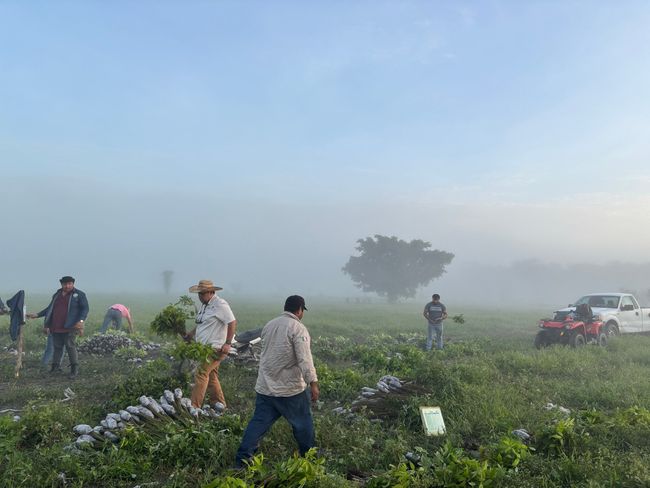
On Yucatán, planting happens during the rainy season. In the first weeks, the seedlings need enough water to get through the dry season that follows. According to the Yucatán Restoration Report 2025, the 2025 season ran from 3 July to 15 December. According to the 2025 transparency report, 1,723,843 trees went into the ground in that time, from 23 native species.
For comparison, here are the earlier seasons, as Plant-for-the-Planet lists them on its project page (2025 period from the restoration report):
| Season | Trees planted | Period |
|---|---|---|
| 2025 | 1,723,843 | 3 July to 15 December |
| 2024 | 1,746,074 | 18 July to 5 December |
| 2023 | 2,288,521 | 2 August to 22 December |
| 2022 | 2,386,462 | 3 June to 13 December |
Since 2015, the project reports a total of 17,899,148 trees.
2026: two and a half months late
Planting normally starts between June and August. Not this year. In August, Plant-for-the-Planet wrote to its supporters that a particularly strong El Niño is expected for 2026 and that Campeche is much hotter and drier than usual. So the team wanted to wait with planting until early September, in the hope that the rainy season would bring enough rain by then.
In the end it took even longer. On 15 October, Plant-for-the-Planet announced on Instagram (in German) that the planting season in Mexico had finally started, two and a half months late. Until then, the soil was simply too dry for the young seedlings to take root.
That sounds like a delay, but it’s exactly the right call. A seedling that goes into dry soil has hardly any chance. Better later, and with water.
How Plant-for-the-Planet monitors the sites
There’s no photo of every single tree, not even at Plant-for-the-Planet itself. In its FAQ, the foundation says so openly: you can follow the planting sites, not the individual tree. Still, what’s published about the sites is quite detailed:
- Every planting site is recorded. The team logs plantings daily in its own app, TreeMapper. You can view the sites with satellite imagery on the Plant-for-the-Planet platform.
- Survival is measured. Since 2021, a team has been measuring on control plots how many trees are still standing after one year. The results per season are on the project page, the bad ones too.
- Incidents are public. Plant-for-the-Planet lists fires and other damage on its own incidents page.
Fire remains the biggest risk
In April and May 2025, two large wildfires hit the restoration sites near Constitución. According to the transparency report, around 425,000 seedlings from 2023 and 2024 were largely lost on the Las Américas 7a site. Older plantings from 2021 and 2022 have largely recovered. Some sites have to be replanted; on Las Américas 7a, replanting already started in 2025, according to the restoration report.
We mention this because it’s part of the picture. Reforestation in an area with a dry season is not a given. Plant-for-the-Planet responds with fire protection: every year the team is trained by the Mexican forestry authority CONAFOR, creates firebreaks in vulnerable areas and monitors the region with the satellite app FireAlert.
More than trees: the jaguar corridor
In Campeche, Plant-for-the-Planet also works on protecting existing forests. Together with Campeche’s environment ministry and other organisations, the foundation has launched the Balam Beh jaguar corridor (in German), which connects forest areas so that jaguars and other animals keep large, continuous habitats.
What this means for your review forest
Through ReviewForest, you fund trees in this project. Planting happens in the rainy season, so trees are planted in batches per season and not on the day a review comes in with you. You’ll find everything about the project, the video from the planting sites and the map on our Plant-for-the-Planet partner page.
So the 2026 season is under way right now. As soon as Plant-for-the-Planet publishes the numbers for it, we’ll write the next update here.
