


Trees for the Future (TREES) has been our planting partner in Uganda since February 2026. Back then we explained how the model works. Now, eight months later, we want to show what is actually happening there. Everything here comes from reports that TREES has published itself.
A quick reminder: how TREES works
TREES doesn’t plant on large areas of its own, but with smallholder families on their land. Each family goes through a four-year programme and builds a so-called forest garden: fast-growing trees that improve the soil, plus fruit and nut trees, timber trees and vegetables in between. In Uganda, TREES works in the east of the country, in the catchment area of Lake Victoria, for example in Bududa on Mount Elgon and in the Busoga region.
Grace and her forest garden in Bududa
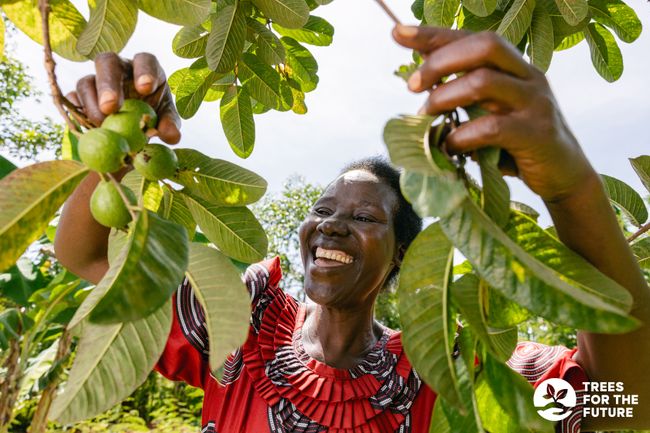
In June, TREES told the story of Grace Faith Wambi. She was a teacher for 20 years, has five children and has been in the programme since 2020. Today, in Bududa at the foot of Mount Elgon, she leads a group with 22 other farmers. On her farm, tomatoes, onions, beans, hibiscus and plantains grow between the trees. She’s also the treasurer of the local savings and credit group, where members lend each other money.
Her verdict is pretty clear. Grace says: “The TREES’ program has brought a lot of food to my household.”
What we like about this story is that it shows why the trees there are looked after: they belong to a farm that a family lives from.
A species survey with Makerere University
In February, TREES published the results of a biodiversity study in the Busoga and Buganda regions. Together with Dr. Samuel Ojele from Makerere University in Kampala, the team set up sample plots, and recorded plants and animals, including on surveys at night.
Among other things, they found the grey crowned crane, Uganda’s endangered national bird, as well as African fish eagles, rock pythons, green monkeys, a forest frog and a butterfly called Anderson’s Grass Yellow. What’s the point? The study records what lives in the landscape today. Only with a baseline like that can you tell in a few years whether something has improved. A detailed report is still to come.
The numbers
TREES publishes an impact report once a year. For Uganda there’s a separate breakdown in the 2024 report: 12,976,620 trees planted, 5,718 forest gardens and 44,005 people reached. The 2025 report only gives figures for the whole organisation: from July 2024 to June 2025, 49,940,320 trees were planted and 4,056 new farming families joined, with no separate figure for Uganda.
A new focus on East Africa
In the same report, TREES CEO Tim McLellan writes that the organisation decided to close its projects in West Africa by the end of 2025. TREES now concentrates on Kenya, Tanzania and Uganda. In September, TREES published its new strategy, “Roots to Rise”.
What this means for your review forest
Through ReviewForest, you fund trees in this programme. TREES reports its numbers per country and year, and there’s no photo of every single tree. Planting follows the rhythm of the programme on the ground, not the day a review comes in with you. You can find more about the project on our Trees for the Future partner page.
