


Some of our customers have been seeing reviews show up lately that don’t represent any real customer experience. Instead, the “reviewer” is quietly pitching the business a service: pay them, and they’ll get negative Google reviews taken down. That’s spam, it clearly violates Google’s policies, and it’s hitting businesses across industries and countries.
The scheme comes in two flavors that get very different amounts of attention. Both should be reported to Google as soon as they show up, even when the first one doesn’t look particularly urgent.
Variant 1: The disguised 5-star review
This is the quieter version. A perfectly harmless-looking positive review shows up on your Google profile. Look at the text and you’ll see no actual experience with your business, just the recruitment pitch:
Please read this. I have noticed that your business has some negative reviews, which may harm your business reputation and future. I can professionally assist in removing these negative reviews and also help you gather positive ones. If you are interested in this service, please contact me via the details in my profile.
Or a shorter variation:
If you want to remove negative reviews from your Google Business, contact me via my profile; my contact details are listed there. After work you can pay.
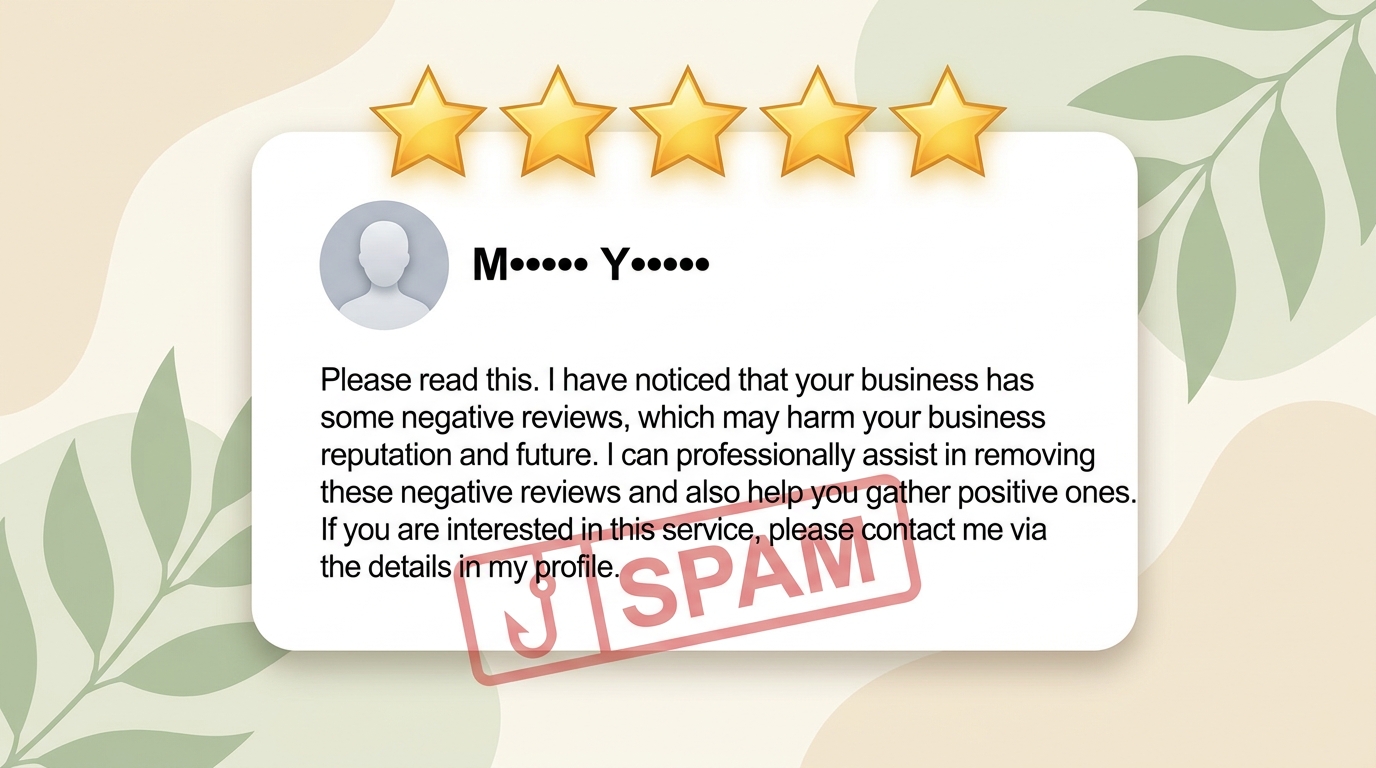
The stars are just camouflage. The real content of the “review” is an advertisement for a service that violates competition law in most jurisdictions and that Google itself explicitly forbids. This variant isn’t well-documented in industry coverage yet. We’ve been seeing more and more of it among our customers.
Variant 2: The classic 1-star extortion
The much better-known one. Within 24 to 48 hours, a wave of negative reviews lands on a Google profile, often with invented service complaints. Soon after comes a WhatsApp or email message: “We’ll take them down if you pay.”
That pattern is by now very well documented. Joy Hawkins at Sterling Sky wrote about it in detail in February 2026, BrightLocal published a guide in October 2025, ConsumerAffairs reported on affected small businesses in September 2025 (one example: a Los Angeles contractor whose rating dropped from 5.0 to 3.6 within days), and Google itself published a dedicated fraud advisory update in November 2025.
The damage here is more immediate and obvious: a tanked rating costs you real inquiries right away.
Why the 5-star variant deserves a report too
A disguised 5-star review hurts less at first glance than a barrage of 1-stars. It’s still spam, and there are several reasons to report it just as consistently:
- No one wants to be visibly associated with this kind of vendor. Click on the reviewer’s name and you land on a profile that openly offers a service for manipulating Google reviews, something that violates Google’s policies and, in most countries, competition law. As long as that review is up, that association is sitting right on your profile.
- Other profile visitors are reading the pitch too. Anyone who looks at your Google profile and clicks through to the reviews sees the solicitation text the same way you do. That reads as unprofessional, regardless of how many stars sit next to it.
- A spam cluster stays a spam cluster. Google is now going after organized review operations more aggressively, including automatic pauses on suspicious review spikes. If fake reviews are still sitting on your profile when that hits, your profile can get caught in the net.
Short version: the star count is the disguise, the actual content is advertising for a black-market service. That’s exactly what Google’s content policies and reporting tool are for.
Who’s behind it
Profiles like these belong to so-called click farms, networks with hundreds of fake accounts that place reviews on demand. Investigations like the one by France 24 have exposed individual operations, based across South and Southeast Asia. The give-away isn’t really the name, it’s the profile behind it: such accounts have basically no activity apart from this one review, no profile picture, no reviews of any other businesses. Click on the reviewer’s name and you’ll see it within seconds.
How to get the review removed at Google
Spam reviews with an embedded service pitch clearly violate Google’s content policies, both the advertising and solicitation rule (“posting email addresses, phone numbers, social media links, or links to other websites in your reviews”) and the off-topic rule (a review needs to describe a real experience with the business). That puts you in a strong position to ask for removal.
Three paths, in descending speed:
Path 1: Report the review directly from your Business Profile
- Sign in at business.google.com
- Go to “Read reviews”
- Click the three dots next to the review
- Select “Report review”
- Choose “Spam” as the reason
That takes thirty seconds and is the fastest path. Google’s stated processing time is three business days; in practice with these solicitation reviews it’s often longer, because the automated filter doesn’t always recognize an embedded sales pitch as spam.
Path 2: Reviews Management Tool
If the direct report doesn’t go anywhere, use Google’s official Reviews Management Tool (the URL is almost impossible to find through normal navigation, but this is the right one). From there you can:
- track the status of your reports,
- file an appeal if a review wasn’t removed,
- submit a more detailed justification.
When you write the justification, be as concrete as possible: “The review does not describe an experience with our business. Instead, the author offers a service for removing negative reviews and refers to contact details in their profile. This is a direct violation of Google’s content policies for advertising and solicitation, and for off-topic content.” A justification like this gets reviewed by an actual human at the escalation stage rather than just being auto-screened.
Path 3: If money was demanded
If someone actually contacted you and demanded money to remove reviews (Variant 2, the classic extortion), that belongs in Google’s dedicated Extortion report form. What helps:
- Screenshots of the WhatsApp or Telegram conversation
- Links to the suspicious reviews
- Name, phone number, profile pictures, anything that identifies the reviewer
Reports of this kind get prioritized, and in most documented cases not just the single review gets removed but the entire reviewer profile gets banned. Anecdotal success rates are noticeably higher than for Path 1.
What you should never do
Reply to the message or the pitch. As soon as your profile is marked as “responsive”, the pattern typically continues like this:
- A small “pilot package” gets offered, typically 150 to 300 euros, where the scammer reports a few actually policy-violating reviews (that Google would remove anyway). You’re paying for work you could have done yourself in two minutes.
- The second payment switches to crypto, after which the trail is effectively untraceable, and delivery isn’t guaranteed.
- Some operations escalate, placing actual 1-star reviews later to apply pressure. That’s exactly the pattern described in the BrightLocal and Sterling Sky reports above.
The right move here is the same: don’t reply, take screenshots, report via Path 3 above.
What we do on our side
If you spot a spam review like this in your review forest, just drop us a quick note at [email protected]:
- We’ll remove the corresponding tree from your forest right away, so the spam review doesn’t keep dragging down your profile with us.
- If we already invoiced for that tree, we’ll issue a credit note. You won’t be paying us for fake content.
- If you’d like, we’ll help you word the report to Google. The justification in the appeal form often makes the difference between success and failure.
What’s changing right now
Google is responding to schemes like these with better filters (Gemini-based spam detection, automatic pauses on review floods) and with more transparency, which we covered in our post about the defamation banners on Google Maps. In April 2026, Google tightened the review policy again, and in the Trust & Safety Report Google cites 292 million policy-violating reviews removed in 2025, a 21% jump over the previous year.
Between a new spam wave going live and the moment Google’s filter reliably catches it, though, there’s almost always a window of weeks. Anyone who does nothing during that window lives with a visible spam review sitting on their profile.
So the rough playbook for the coming weeks: read reviews regularly, don’t just count stars. Report suspicious ones right away via Path 1 or 2, and via Path 3 if there’s a money demand. Don’t reply. And if the review is sitting in a forest with us, drop us a quick line. The rest is handled either by Google or by us.
