


If you run a local business, like a plumbing company, a restaurant, a dental practice, or a gym, local SEO is how you get found by the people in your area who are actively looking for what you sell. Done right, it’s the cheapest source of leads you’ll ever have.
The whole playbook fits on one page. Here it is.
Your Google Business Profile is the game
Not your website. Your Google Business Profile (GBP). That’s the listing that pops up when someone searches for your business, with your address, hours, photos, and reviews. It’s also what powers the three results that sit at the top of any “near me” search. That stack of three is called the map pack, and it gets sixty to seventy percent of all local leads.
If you’re not in the map pack, you don’t exist for most local searches.
Everything below this line is downstream of that one fact.
Set up the profile properly, or don’t bother
Verify with a physical address. Service-area businesses without a verified location get crushed. If you don’t have an office, rent the cheapest one you can find and put a sign on the door. Do it properly. Google catches the shortcuts.
Pick the right category. Search your main keyword and look at what the top three results are using. Match that. Picking the wrong primary category alone can tank your rankings overnight.
Make your business name work. An exact-match name is a cheat code. “San Antonio Plumbing Company” will outrank competitors with five times the reviews. If your legal name is generic, register a DBA (a “doing business as” name you file with your state or local registry), make it official, then update the profile. The single biggest free win in local SEO.
Fill out the full description. All 750 characters. Include your keywords and the cities you serve, naturally. Don’t keyword-stuff. Don’t leave it blank either.
Stay active. Google wants a pulse.
- Post an update every week. Use your keywords.
- Answer the Q&A section every week. Use your keywords.
- Upload fresh photos and videos every week.
- Respond to every review. Use your keywords there too.
Dormant profiles get treated like dormant businesses. They drop.
Reviews are the whole game
Forty to fifty percent of how Google ranks you locally comes down to reviews. You need more than your competitors. Not the same number. More.
Quality matters too:
- Reviews from Google Local Guides (a Google program that rewards prolific reviewers with badges and perks) count for more than reviews from random accounts.
- Reviews with photos and a few sentences of detail count for more than five-word reviews.
- Reviews from the last 90 days count for the most. Old reviews fade.
One warning while we’re on the topic: if you see suspicious-looking reviews on your own profile or your competitors’, report them. There’s been a wave of fake-review extortion targeting local businesses, and Google has gotten more transparent about which reviews it removes.
This means you can’t ask once and forget. You need a steady drip.
The boring approach works: ask every customer at the end of the job. Most won’t do it. Some will.
Want more? Add free value to create extra touchpoints. Free estimates, free inspections, free anything. Give the value first, then ask. And once a month, run an offer so good that you stack twenty reviews in a single day. Google reads the spike as momentum.
There’s a quieter pattern that works even better: make the ask feel like a gift instead of a chore. The simplest version is to plant a tree for every review. Suddenly the customer isn’t doing you a favor. You’re doing something together that you both care about, and you happen to benefit. Conversion on the ask climbs dramatically, and the reviews themselves tend to be longer and more thoughtful because the customer is actually engaged, not just ticking a box.
(Disclosure: this is what we make ReviewForest for. Every Google review plants a real tree with a verified reforestation partner. There are other ways to run the same play. The principle is the part that matters: reframe the ask from “favor” to “shared mission” and the numbers move.)
Don’t skip the boring infrastructure
Citations. A citation is just a mention of your business name, address, and phone number on another website. Think directories: YellowPages, Yelp, BBB, Chamber of Commerce, Apple Maps, Bing, plus any industry-specific ones. Get listed on all of them with the exact same name, address, and phone number on every one. Inconsistency confuses Google and you lose rankings for no reason at all.
Backlinks. Local sources. Real businesses. Sponsor a local 5K. Get a mention in the local paper. Join the chamber. Quality beats quantity by a wide margin. Do not buy backlink packages from Fiverr. They will destroy your site faster than anything else on this list.
Open more than one GBP if you can
A single profile has a limited geographic radius. Two profiles in different parts of your city roughly doubles your coverage. Three triples it. Each office becomes its own lead engine.
This is more work. Real offices, real signage, real verification. But if you can pull it off, it’s the highest-leverage move in this whole document.
Real caveat: Google requires each profile to be a distinct, staffed location. Fake ones get suspended, and getting a suspended profile reinstated is brutal. Do it properly or don’t do it at all.
Your website still matters
The map pack is the priority, but your website backs it up. Keep it simple:
- Primary keyword in the meta title, near the start.
- Primary keyword in the H1.
- Primary keyword in the URL.
- At least 500 words of real copy about that keyword on the page.
- Your full address in the footer of every page.
Then build location pages. One page per city you want to rank in. You can’t target thirty city-keyword combinations on one homepage. Each city gets its own page, its own copy, its own local context. This is where most local sites quietly run out of headroom.
What NOT to spend time on
Blog posts, mostly. Nobody searching “plumber near me” cares about the history of plumbing. Generic top-of-funnel content doesn’t drive local business. Build pages that target buyers. Service pages, city pages, comparison pages. Not browsers.
Low-ticket services. High-ticket and commercial work is easier to rank for than low-ticket residential. Fewer competitors, less sophisticated players, more margin to fund the SEO work. If you have a choice in what to push, push the higher-ticket stuff and let it pull the rest.
Timeframes
Local SEO takes three to six months to show real movement. GBP rankings come faster than website rankings, but neither is instant.
If you need leads tomorrow, run ads. If you want a steady, cheap stream of leads for the next decade, invest in SEO. Both is fine. Pretending SEO will fix this quarter is not.
One more. The one that costs people the most money: answer your phone. Respond to form fills inside sixty seconds. Speed to lead is everything. The best SEO campaign in the world is worthless if a lead calls and you don’t pick up.
AI search isn’t coming. It’s here.
Everyone wants to talk about ChatGPT, Claude, and Perplexity, but the bigger shift for local businesses is happening inside Google itself.
At Google I/O 2026, Google announced that AI Mode, the AI-powered version of Google Search, has crossed 1 billion monthly users in just over a year. AI Overviews (the AI summary that appears above regular search results) reaches 2.5 billion users a month. The Gemini app itself has 900 million. The way people search for businesses has already changed, whether you’ve noticed or not.
And then there’s Maps. Google’s new “Ask Maps” feature, built on Gemini, lets people ask Maps conversational questions like “Find a cozy date-night restaurant with great vegetarian options and a view.” Gemini answers by reading and summarizing your reviews. Google specifically calls out that Ask Maps draws on “community reviews from more than 500 million contributors globally.”
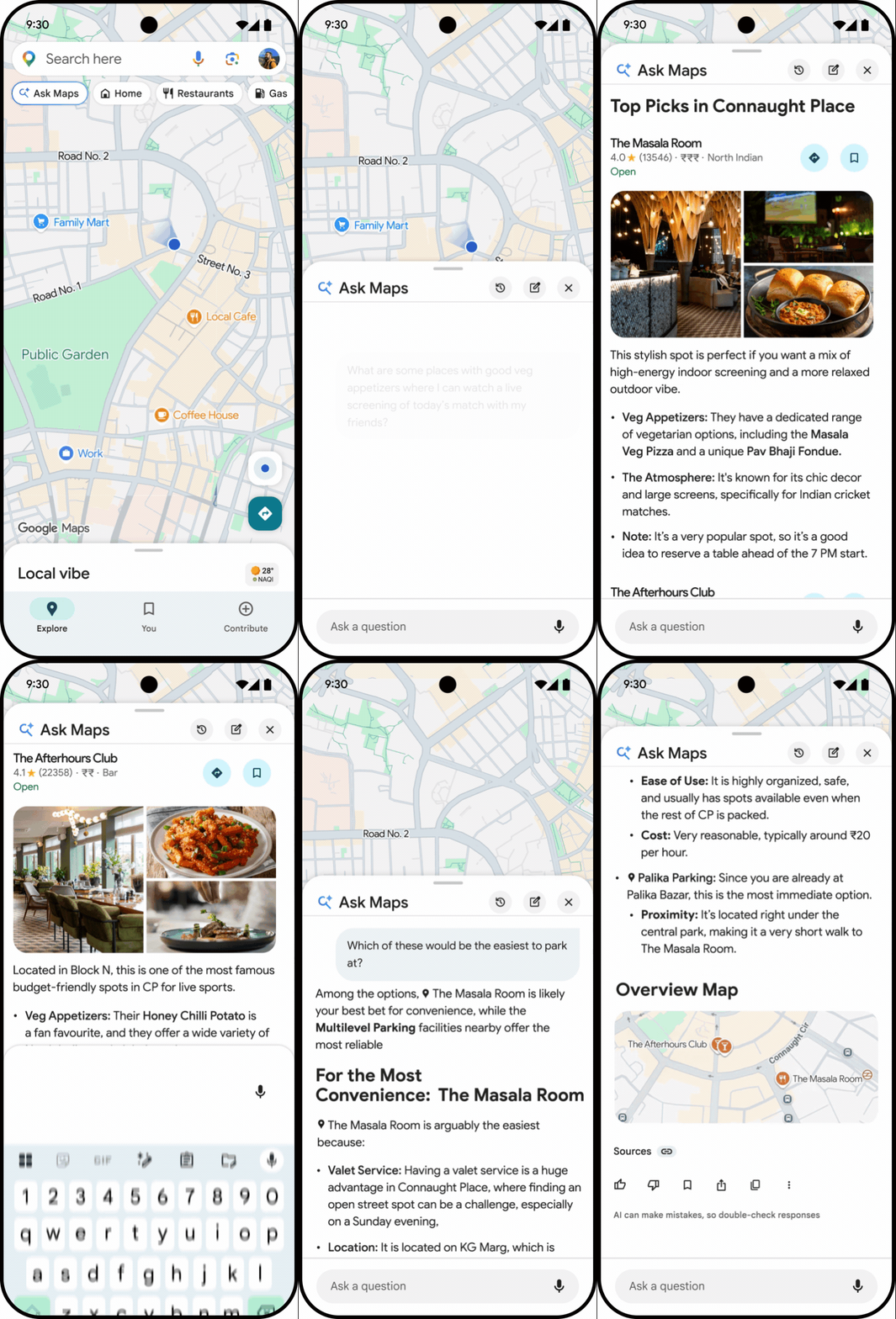
Ask Maps in action: Gemini reads a place’s reviews and turns them into a summary with the relevant angles for the question (“Veg Appetizers”, “Atmosphere”, “Pro-tip”). Your business gets surfaced like this only if the reviews say enough for Gemini to summarize. Image: Google.
AI isn’t replacing reviews. It’s making them more important. The businesses Gemini recommends in its AI summary are the ones with more reviews, fresher reviews, and reviews with actual detail in them. Exactly what wins the map pack.
The good news: roughly ninety percent of what gets you ranked in AI Mode and Ask Maps is the same thing that gets you ranked in regular Google. Strong GBP. Good reviews. Consistent citations. Real backlinks. Clean website. Get the basics dialed in and you’re already ahead on AI search by accident.
The window is closing
Local SEO will never be as easy as it is right now. Every year more competitors wake up. Every year the bar moves higher.
Businesses that start in 2026 will have a moat by 2028. Businesses that wait until 2029 will be fighting uphill against everyone who built three years of momentum first.
If you’ve read this far, you have the whole playbook. The only question left is whether you actually do it.
